What Is Programmatic Advertising? Tech & Benefits
In the fast-paced world of digital marketing, staying ahead means embracing automation and data-driven strategies. Enter programmatic advertising—a game-changer that’s revolutionizing how ads are bought and sold. But what exactly is it, and why should digital marketers, agencies, and business owners care in 2025?
Programmatic advertising automates the buying and selling of ad space using technology, making it faster, more efficient, and targeted than ever before. It’s not just a buzzword; it’s the backbone of modern digital ads. According to recent forecasts, programmatic advertising will account for nearly 9 in 10 digital display ad dollars worldwide in 2025. This staggering growth—up from about 80% a few years ago—highlights its dominance in the industry. With global programmatic ad spend projected to approach $800 billion by 2028, it’s clear that businesses ignoring this technology risk falling behind.
Whether you’re a small business owner dipping your toes into online ads or an agency optimizing campaigns for clients, understanding programmatic advertising can unlock new levels of efficiency and ROI. In this article, we’ll break it down step by step, from the basics to its benefits, challenges, and future trends. Let’s dive in.

What Is Programmatic Advertising?
At its core, programmatic advertising is the automated process of buying and selling digital ad inventory in real time. Unlike traditional media buying, where negotiations happen manually via emails, phone calls, or insertion orders, programmatic uses algorithms and data to handle transactions instantly.
Think of it as the stock market for ads: advertisers bid on impressions (views of an ad) as they become available, and the highest bidder wins—all in milliseconds. This programmatic ad buying shifts the focus from bulk purchases to precise, data-informed decisions.
How It Differs from Traditional Media Buying
Traditional ad buying often involves direct deals with publishers, long lead times, and fixed prices. For example, you might contact a website owner to reserve banner space for a month at a set rate, regardless of audience relevance.
In contrast, programmatic advertising leverages technology platforms to automate these processes. It allows for dynamic pricing based on demand, audience data, and performance metrics. This means ads are served to the right people at the right time, reducing waste and increasing effectiveness.
Example Scenario: Manual vs. Automated Ad Buying
Imagine you’re a clothing brand launching a summer sale. In the manual approach, you’d negotiate with multiple sites, buy ad slots in advance, and hope your audience sees them. If the campaign underperforms, adjustments take days or weeks.
With programmatic ad buying, you set parameters like target demographics (e.g., women aged 25-34 interested in fashion) and budget. The system automatically bids on relevant ad spaces across thousands of sites, apps, and devices. If sunny weather spikes interest in beachwear, the algorithm optimizes in real time, shifting spend to high-performing placements.
This efficiency is why programmatic has become essential. For more insights, check out StackAdapt’s guide on programmatic advertising.
How Programmatic Advertising Works
Programmatic advertising relies on a ecosystem of platforms and technologies working in harmony. Here’s a breakdown of the key players and processes.
The Role of Key Platforms
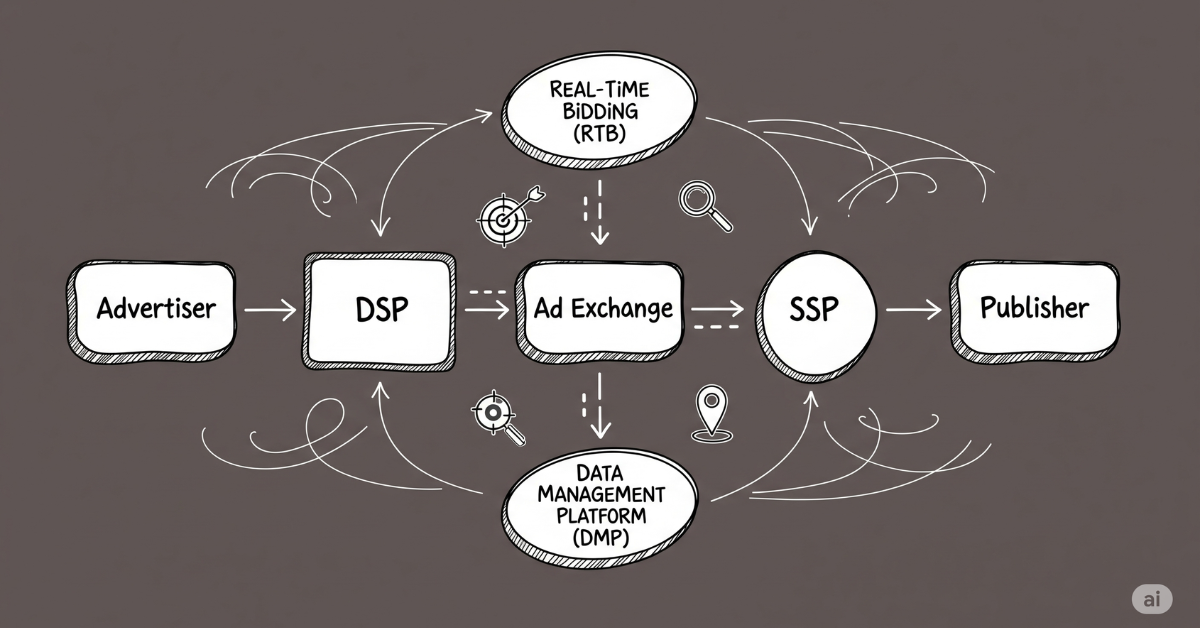
- DSP (Demand-Side Platform): This is the advertiser’s tool. A DSP allows you to manage campaigns, set targeting criteria, and bid on ad inventory. Popular DSPs include Google Display & Video 360 and The Trade Desk.
- SSP (Supply-Side Platform): Publishers use SSPs to sell their ad space. It connects inventory to ad exchanges, optimizing revenue by selecting the best bids.
- Ad Exchanges: These are digital marketplaces where DSPs and SSPs meet. Think of them as auction houses facilitating real-time transactions between buyers and sellers.
- DMP (Data Management Platform): A DMP collects and organizes audience data from various sources, helping advertisers target users based on behaviors, interests, and demographics.
Together, these components create a seamless flow: Publishers make inventory available via SSPs, which feed into ad exchanges. Advertisers bid through DSPs, using DMP data for precision.
Real-Time Bidding (RTB) Explained Step-by-Step
RTB is the most common form of programmatic ad buying. It’s like an eBay auction for ad impressions, but lightning-fast. Here’s how it works:
- A user visits a website or app, triggering an ad slot to load.
- The publisher’s SSP sends details about the user (e.g., location, device, browsing history—anonymized for privacy) to an ad exchange.
- The ad exchange broadcasts this to multiple DSPs, inviting bids.
- DSPs evaluate the impression against advertisers’ criteria and submit bids in milliseconds.
- The highest bidder wins, and their ad is served to the user.
To simplify with an analogy: Imagine a busy auction where bidders (advertisers) shout offers for items (ad slots) as they appear on a conveyor belt. The auctioneer (ad exchange) picks the top bid instantly, ensuring the item sells before it moves on.
Programmatic Direct vs. RTB
Not all programmatic is auction-based. Programmatic direct involves pre-negotiated deals with fixed prices, combining automation with guaranteed inventory. It’s ideal for premium placements where brands want certainty, unlike the open competition of RTB.
For a deeper dive, War Room Inc guide to Programmatic direct vs RTB is a great resource.
How Programmatic Advertising Works
The shift to programmatic isn’t just hype—it’s driven by tangible advantages that help businesses scale and succeed.
Efficiency & Automation
Manual buying is time-consuming; programmatic automates it, freeing marketers to focus on strategy. Campaigns launch faster, with algorithms handling bidding and placement.
Advanced Targeting
Reach audiences with laser precision:
- Demographics: Age, gender, income.
- Interests: Based on browsing history or app usage.
- Geolocation: Target users in specific cities or even stores.
- Device and Time: Optimize for mobile during commute hours or desktops at work.
This reduces ad waste—for instance, showing travel ads to frequent flyers rather than everyone.
Real-Time Optimization
Algorithms analyze performance instantly, adjusting bids or creative elements. If an ad underperforms on weekends, spend shifts to weekdays automatically.
Cost-Effectiveness
Pay only for valuable impressions via bidding, often at lower costs than fixed-rate deals. In 2025, with programmatic dominating 90% of digital display spend, economies of scale make it even more affordable.
Transparency & Reporting
Detailed analytics track every impression, click, and conversion. This data empowers better decisions and proves ROI to stakeholders.
Overall, the benefits of programmatic advertising include higher engagement rates and up to 30% cost savings compared to traditional methods. Learn more about Adsarge’s programmatic advertising services to see how we can implement these for your business.
Types of Programmatic Advertising
Programmatic isn’t one-size-fits-all. Here are the main types:
- Open Auction / RTB : The public marketplace where anyone can bid. Great for broad reach but competitive.
- Private Marketplaces (PMPs) : Invitation-only auctions for premium inventory. Publishers control who participates, ensuring brand safety.
- Preferred Deals : Direct negotiations with variable pricing, automated through programmatic tech. Offers priority access without auctions.
- Programmatic Guaranteed : Fixed-price deals for reserved inventory, blending traditional guarantees with automation. Ideal for high-value campaigns.
Choosing the right type depends on your goals—RTB for volume, guaranteed for predictability.
Challenges and Considerations
Ad Fraud & Brand Safety
Bots can inflate impressions, wasting budgets. Solutions include verification tools and blacklists to avoid unsafe sites.
Privacy and Cookie Deprecation
With third-party cookies phasing out (Google’s full deprecation in 2025), targeting relies more on first-party data and contextual signals. Compliance with GDPR and CCPA is crucial.
Tech Complexity
Setting up DSPs and integrating data can overwhelm newcomers. Partnering with experts like Adsarge mitigates this.
Addressing these ensures sustainable success. For stats on ad fraud, Spider Af’s programmatic forecast provides valuable insights.
The Future of Programmatic Advertising (2025 and Beyond)
As we hit 2025, programmatic is evolving rapidly, driven by tech advancements and shifting consumer behaviors.
AI & Machine Learning in Ad Buying
AI enhances bidding strategies, predicts user behavior, and personalizes creatives. In 2025, expect AI to automate 80% of ad optimizations, boosting efficiency. Machine learning will analyze vast datasets for hyper-targeted campaigns.
Programmatic in CTV, Digital Audio, and DOOH
Connected TV (CTV) is exploding, with programmatic CTV spend growing 25% annually. Digital audio (podcasts, streaming) and digital out-of-home (DOOH) like billboards are joining the fray, offering new channels for immersive ads.
Privacy-First Advertising Trends
Post-cookie era emphasizes consent-based data and alternatives like contextual targeting. Trends include federated learning and clean rooms for secure data sharing.
The future of programmatic advertising promises even greater integration across channels, with sustainability and ethics in focus. Stay ahead by exploring Adsmurai’s trends report.
Conclusion
Programmatic advertising is more than a tool—it’s a strategic imperative for efficient, targeted digital marketing in 2025. From automating buys via RTB to leveraging DSPs and SSPs for precision, it offers unmatched benefits like cost savings, real-time tweaks, and advanced reporting.
As challenges like privacy evolve, so do opportunities with AI, CTV, and beyond. Businesses that embrace programmatic will thrive in a data-driven world.
Ready to elevate your ads? Contact Adsarge today to unlock the full potential of programmatic advertising